

Asphalt Shingles: Why You Rarely See Them Here
Search for roofing advice online and most of what comes up is written for North America, where asphalt shingles cover the majority of houses. They are thin, flexible strips made of bitumen and mineral granules, nailed down in overlapping rows.
In Scotland they are known as felt shingles or bitumen shingles, and you will mostly find them on sheds, summer houses, garden rooms and the odd timber lodge. On a main house roof they are rare, for good reasons:
- Wind. A light, flexible strip is easier for a gale to lift than a slate nailed to a board or a heavy interlocking tile.
- Damp. Our roofs stay wet for long spells, which encourages moss and shortens the life of a bitumen product.
- Lifespan. Shingles generally do not last as long as slate or tile, so the saving up front tends to disappear over time.
- Looks and planning. They do not match the slate and tile streets of Scottish towns, and in a conservation area the council is unlikely to accept them.
So if an article tells you to weigh up shingles against everything else, it was not written with your house in mind. The rest of this guide compares the coverings that are fitted on Scottish homes every week.
The Main Options At A Glance
| Covering | Best suited to | Relative cost | How long it tends to last |
|---|---|---|---|
| Natural slate | Sandstone villas, tenements, cottages, conservation areas | Highest | The longest of any covering, often several generations |
| Concrete tile | Post-war semis, terraces, bungalows, modern estates | Lowest for a pitched roof | Many decades |
| Clay tile and pantile | East coast and character homes | Middle to high | Many decades, and it keeps its colour |
| Metal | Modern extensions, low pitches, rural buildings | Varies widely | Long, if the coating and fixings are right |
| Flat roof membrane | Extensions, dormers, garages, porches | Priced by area | Far longer than old felt |
As a guide to budget, most full re-roofs we price land between £7,500 and £18,000 fully fitted, including scaffolding. Larger detached homes and natural slate jobs can go well beyond that. Our post on the cost of a new roof in Glasgow breaks the figures down by house type.
Natural Slate: The Traditional Scottish Roof
Slate is a natural stone split into thin sheets. It does not rot, it shrugs off frost, and sunlight does not break it down. That is why so many Victorian roofs in Glasgow and Edinburgh still have their original slates, even where the nails and timber beneath have given up.
A Scottish slate roof is usually nailed straight onto timber boards called sarking, rather than onto thin battens as in England. The boards stiffen the roof and help it cope with high winds.
Your choices today are Scottish slate (mostly reclaimed, as the big quarries closed long ago), Welsh slate, and Spanish slate, which is the most widely used and the most affordable of the three.
- For: the longest life, the right look on stone houses, accepted in conservation areas.
- Against: the highest cost, and it takes longer to lay because every slate is sorted and nailed by hand.
There is more detail on our natural slate roofing page, including how the three types of slate differ.
Concrete Tiles: The Everyday Workhorse
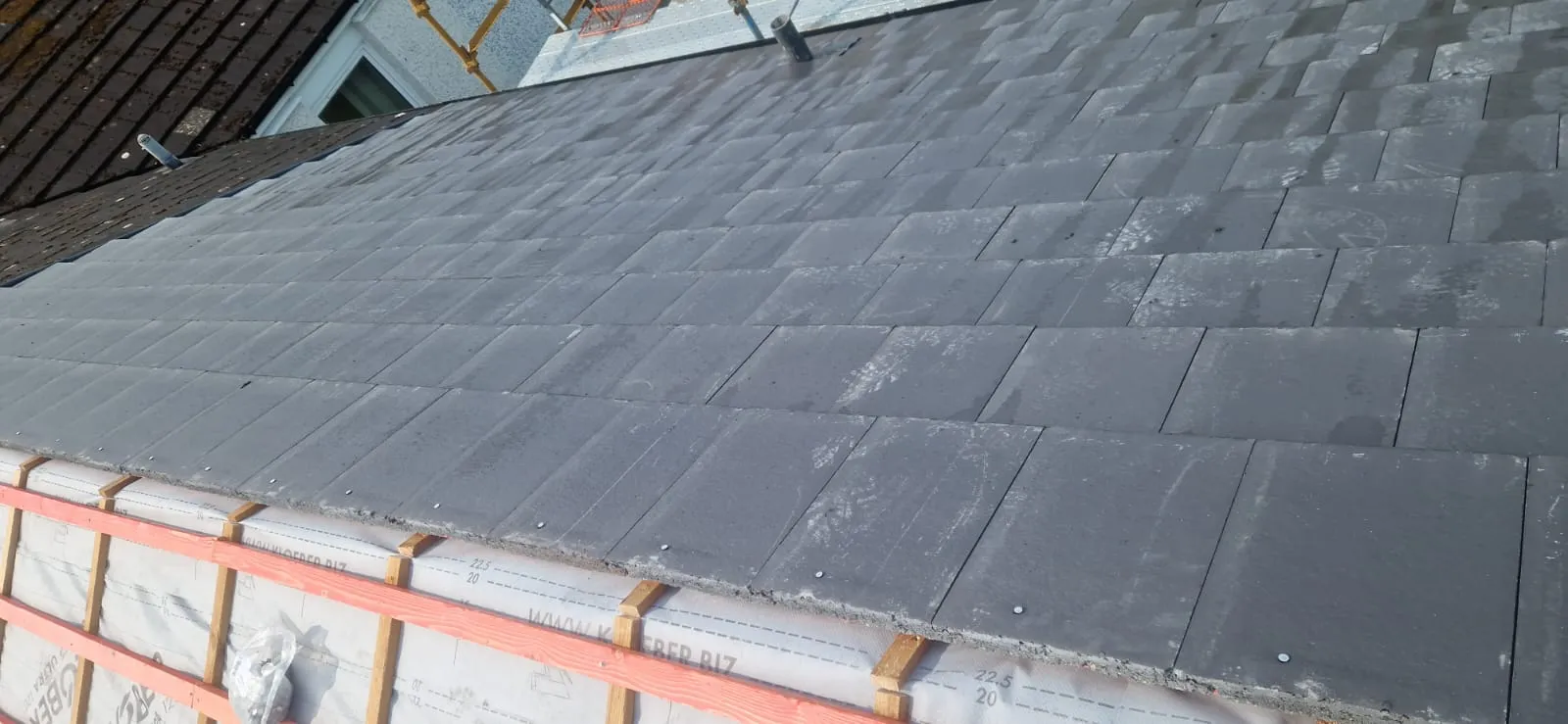
Most houses built in Scotland since the war have concrete tiles. They are made in a factory, they lock together, and they go on quickly, which is why they are the best value choice for a full re-roof.
They come in flat and rolled shapes and a good range of greys, browns and reds, so matching the rest of the street is rarely a problem.
- For: lowest cost for a pitched roof, quick to fit, easy to replace a single tile later.
- Against: heavy, the surface colour weathers and fades over the years, and they look out of place on a period stone house.
Weight matters if you are thinking of swapping slate for tile, or the other way round. A different covering changes the load on the roof timbers, and the change may need a building warrant, so it should be checked by the surveyor and with your council before anything is ordered.
Clay Tiles And Pantiles
A pantile is a clay tile with an S-shaped curve, which gives a roof that rippled look. Red clay pantiles are part of the character of Fife, East Lothian and other east coast towns, where they have been used for centuries.
Clay is fired in a kiln, so the colour runs right through the tile and does not fade the way a surface coating can. It weathers gently and tends to look better with age.
- For: colour that lasts, real character, right for many older east coast and rural homes.
- Against: dearer than concrete, and pantiles need a reasonable roof pitch to keep driving rain out.
Concrete tiles are also made in a pantile shape. They cost less than clay and suit a rendered bungalow or semi very well.

Metal Roofing
Metal roofs come in two main kinds. Standing seam is long sheets of zinc, coated steel or aluminium joined with raised ribs, the crisp look you see on architect-designed extensions and new rural houses. Metal tile sheets are lightweight steel panels pressed to look like rows of tiles, often with a gritty coating.
Metal is light, works on shallow pitches and goes on fast. It is a sensible answer for a garage, an outbuilding, a low-pitched extension or a roof structure that cannot carry much weight.
- For: very light, quick to fit, good on low pitches.
- Against: rain can be noisier unless the roof is well insulated, it rarely matches a traditional street, and planners in conservation areas are unlikely to allow it on the front of a period house.
To be straight with you, metal is a specialist choice. The four systems we fit on houses most of the time are slate, concrete tile, clay tile and flat roof membranes.

Flat Roof Systems
Slates and tiles only work on a slope. Extensions, dormers, garages and porches with a flat or nearly flat roof need a continuous waterproof layer instead. This is the nearest thing in Scotland to the American asphalt roof, because the old standard was bitumen felt laid in strips, and the joints between the strips are where it eventually leaked.
The modern choices are:
- GRP fibreglass. Laid as a liquid that sets into one hard, seamless shell. Good for smaller roofs with awkward shapes.
- EPDM rubber. A single sheet of rubber cut to size, with no joints across the roof. Good for larger, simpler areas such as garages.
- Built-up bitumen. A modern, multi-layer version of felt, still useful in some situations.
Whatever the system, a flat roof must have a slight slope so water runs off rather than sitting in puddles. See our flat roofs page for how GRP and EPDM compare.
How To Choose For Your Home
Most decisions come down to four questions.
- What is on the roof now, and on the neighbours? Like-for-like is nearly always the simplest route, for looks and for permissions.
- Is the house listed or in a conservation area? The council may insist on natural slate or clay. Check with your planning department before you set your heart on anything.
- What can the structure carry? A surveyor should look at the timbers from inside the loft before recommending a heavier covering.
- How long will you be there? If this is your home for the long term, the dearer covering that lasts longest often works out cheapest per year.
Whichever you choose, the parts you cannot see matter just as much: sound timber, a breathable membrane, proper leadwork round chimneys and good ventilation. If your roof only has a local problem, a roof repair may be all you need, and a good surveyor will say so.
A full re-roof takes up to 14 working days, weather permitting, and all workmanship is guaranteed. If you would rather spread the cost, finance is available from £22 a week, subject to status. You can read more on our new roofs page, or see local detail for Glasgow and Edinburgh.
Quick Answers
Can I have asphalt shingles on my house in Scotland?
Nothing stops you on an ordinary house outside a conservation area, but they are rarely used here. They suit sheds and garden rooms better than a main roof in our wind and rain.
Which roofing material lasts longest?
Natural slate. A well laid slate roof can outlast the people who paid for it, and the fixings and timber usually wear out before the slate does.
What is the cheapest way to re-roof a pitched roof?
Concrete tiles are normally the lowest cost for a full re-roof, because the tiles cost less and go on quickly.
Can I change from slate to tiles?
Sometimes. The weight on the timbers changes, a building warrant may be needed, and in a conservation area the council may refuse. Ask your council's Building Standards and planning teams before you commit.
What is a pantile?
A clay or concrete tile with an S-shaped curve, common on the east coast of Scotland. It gives the roof a rippled look.
How long does a new roof take?
Up to 14 working days for a full re-roof, weather permitting. Natural slate takes longer than tile because each slate is nailed by hand.
Not sure which roof suits your house?
A surveyor looks at your roof from the loft and from outside, shows you samples and gives you a clear, no-obligation quote.


 Google