

On This Page
The Short Answer
If the look is what matters most, integrated wins. When the dishwasher, fridge freezer and washing machine all sit behind matching doors, the kitchen reads as one calm run of furniture instead of a row of boxes in different shades of white and silver.
Freestanding still has a strong case. It usually costs less, gives you more capacity for the same width, lets you pick from a wider range of models, and makes a breakdown a simple swap. And some appliances, like a range cooker or an American-style fridge freezer, are meant to be seen.
So the real question is rarely one or the other. It is which appliances to hide and which, if any, to show off.
Integrated, Built-In And Freestanding Explained
The three terms get used loosely, so it helps to pin them down.
- Fully integrated. The appliance sits inside a unit with a furniture door fixed to its front, so you cannot tell it is there. Dishwashers, fridges, freezers, washing machines and washer dryers all come in this form.
- Semi-integrated. Mostly hidden, but with the control panel left on show above a shorter door. Common on dishwashers.
- Built-in. Fits into a housing in your units, but its own front is the finish you see. Ovens, microwaves, warming drawers and coffee machines work this way.
- Freestanding. Has its own finished casing and simply slots into a space left for it in the layout.

Why Integrated Looks Sleeker
A sleek kitchen depends on unbroken lines. Every freestanding appliance interrupts them: its sides do not line up with the doors, its plinth is different, and there are gaps either side for air. Integration removes all three, because the appliance takes the same door, the same plinth and the same handle or handleless rail as everything else.
That matters most where the kitchen is on view from somewhere else. In an open-plan room the kitchen is part of the living space, and a wall of matching tall units looks like joinery, not a utility room. It is the reason integration is close to standard in our modern kitchens, where handleless doors make any break in the line more obvious.
The same thinking helps in a small room. With fewer visible edges and finishes, a compact kitchen looks less cluttered.
Integrated Against Freestanding
| Factor | Integrated | Freestanding |
|---|---|---|
| Look | Seamless, matches the units | Visible casing, can stand out |
| Capacity for the width | A little less, the housing takes space | More, the full width is appliance |
| Choice of models | Narrower | Wider |
| Upfront cost | Usually higher, plus the matching door | Usually lower |
| Replacing a broken one | Must fit the same housing | Any model that fits the gap |
| Moving house | Normally stays with the kitchen | Can go with you |
| Noise | Furniture door muffles some sound | Nothing in front of it |

Free Home Survey
Planning a new kitchen?
See your new kitchen in 3D before anything is ordered. A designer measures up at home, and trusted installers fit it in 10 to 14 working days.
Finance from £35 a week, subject to status.
Appliance By Appliance
Each appliance has its own balance of looks and practicality.
- Dishwasher. The easiest to integrate and the one most people do. A semi-integrated model is handy if you like seeing how long the cycle has left.
- Washing machine. Many Scottish homes have no utility room, so the machine lives in the kitchen. Integrating it hides the porthole, though the range of integrated models and drum sizes is smaller.
- Tumble dryer. Integrated dryers exist but the choice is limited. A combined washer dryer behind a door is a common compromise.
- Fridge freezer. The biggest single decision, covered in detail in our built-in versus freestanding fridge freezer guide.
- Oven and hob. These are usually built-in rather than hidden. Our guide to freestanding cookers and built-in ovens weighs the options.
- Extractor. A hood can be a feature, or it can disappear into a wall unit or the ceiling.
When Freestanding Is The Better Choice
There are times when hiding everything is the wrong answer.
- A statement cooker. A range cooker under a chimney hood is the heart of many country kitchens, and nobody wants it behind a door.
- Maximum food storage. An American-style fridge freezer holds far more than most integrated models and is freestanding by design.
- Keeping appliances you already own. If your machines are fairly new, planning gaps for them can make sense, and you can integrate them when they need replacing.
- A home you will move from soon. Freestanding appliances can come with you to the next house.
A freestanding appliance can still look deliberate if it sits in a planned space with matching end panels and the right gaps for air, rather than squeezed into whatever is left.

The Mix Most Kitchens End Up With
The most common plan is simple: integrate the dishwasher, washing machine and fridge freezer, build the oven and microwave into a tall housing at eye level, and set the hob into the worktop. Everything noisy or bulky disappears, and the appliances you see are the ones that look good.
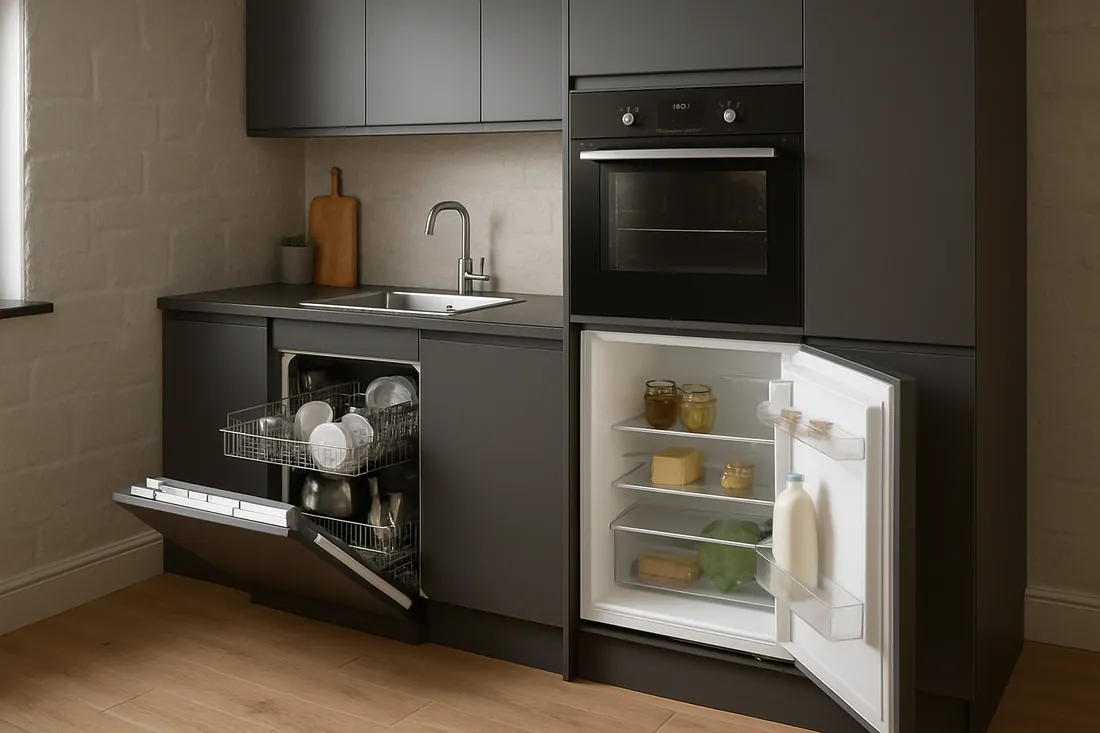
In smaller rooms, integrated slimline models make the biggest difference. A narrow dishwasher and an under-counter fridge behind matching doors free up worktop and keep a compact room calm, which is why they feature so often in our small kitchens.
Think about where each appliance sits, too. A dishwasher next to the sink saves dripping plates across the floor, an oven tower at the end of a run keeps hot doors away from the main walkway, and a fridge near the door lets the family grab a drink without crossing the cook. Hidden or not, an appliance in the wrong spot is a daily irritation.
Planning Appliances Into A New Kitchen
Integrated appliances have to be chosen before the kitchen is finalised, because each housing is sized for the appliance that goes into it. Ventilation gaps, door fixing kits and the height of the plinth all depend on the model, so a change of mind late on can mean a different unit.
During a free home design visit we go through each appliance with you and shows the result in a 3D plan, so you can see exactly which pieces disappear and which stay on show. Appliances can be supplied and fitted with your new fitted kitchen, whichever way you go, for homes from Kilmarnock to Edinburgh. Installation usually takes 10 to 14 working days, and finance from £35 a week, subject to status, can spread the cost.
Quick Answers
Are integrated appliances worth it?
If you want a seamless kitchen, yes. If capacity and low replacement cost matter more, freestanding is better value.
Can you integrate a freestanding dishwasher?
Not properly. A freestanding model has its own casing and no fixings for a furniture door, so buy an integrated one.
Do integrated appliances cost more?
Usually, as the appliance tends to cost more and it also needs a matching door and the right housing.
Can I take integrated appliances when I move house?
You can, but they need a housing of the right size in the new kitchen, so most people leave them behind.
Can you mix integrated and freestanding appliances?
Yes, and most kitchens do. Hide the white goods and let a cooker or a large fridge freezer stand on its own.

Want a kitchen with nothing out of place?
Every appliance, hidden or on show, is drawn into a 3D layout of your room on a free design visit, followed by a clear quote with no obligation.
Fitted Kitchens Near You
Free home visits across Scotland, with showrooms in Glasgow and Kilmarnock. Pick your area or a style to see local work.


 Google