

First, Do You Need A New Roof At All?
Not every leak means a new roof. A few slipped slates after a storm, a cracked ridge tile or a split piece of lead can usually be put right with a roof repair.
Replacement starts to make sense when the problems are spread across the roof rather than in one spot:
- slates or tiles slipping in several places, which often means the nails or the timber beneath are failing;
- pinpricks of daylight when you stand in the loft with the light off;
- a dip or wave along the ridge line;
- damp patches on upstairs ceilings that come back after each repair;
- a roofer called out several times in a couple of years.
A good survey will tell you honestly which side of the line you are on. If a repair will do the job, you should be told so.
Step 1: The Survey
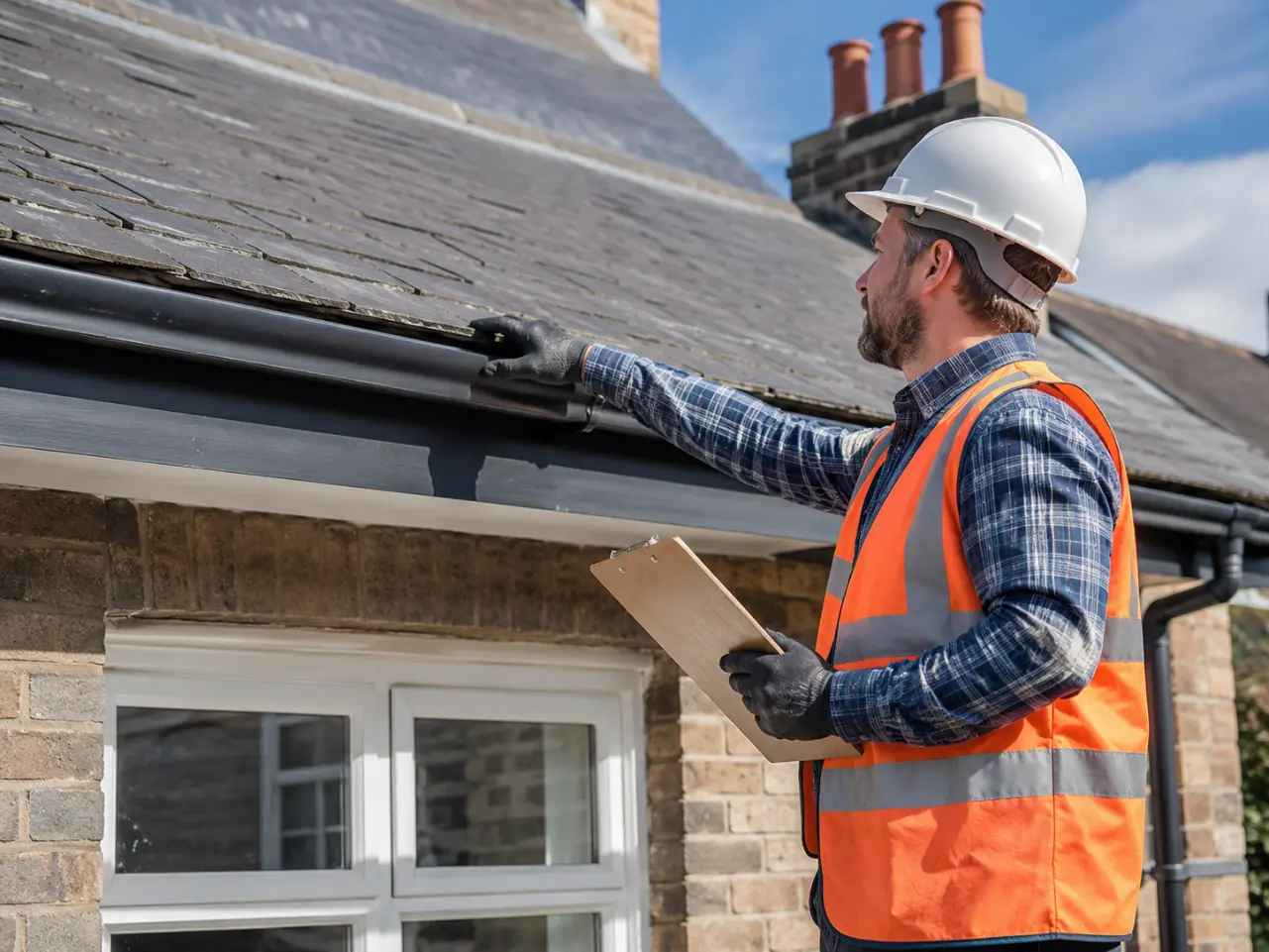
Everything starts with someone looking properly at the roof, inside and out. Inside the loft, the surveyor checks the timbers, the underside of the covering, the insulation and any signs of water. Outside, they look at the slates or tiles, the ridge, the chimneys, the lead and the gutters.
Ask for photographs. You cannot see your own roof from the ground, so pictures of each problem let you judge the advice for yourself.
This is also when you talk about the covering. Most roofs are replaced like for like, slate for slate or tile for tile. If you are thinking about a change, our guide to roofing materials for Scotland explains the options.
Step 2: The Quote And Any Permissions
After the survey you receive a clear, no-obligation quote. It should tell you what covering is being fitted, what happens with the scaffolding, what is allowed for timber repairs, and what is being done at the chimneys, ridge and gutters. Our post on the cost of a new roof in Glasgow shows what should be in the price and which costs tend to appear once the old roof is off.
On permissions, the general position in Scotland is that replacing a roof covering like for like is straightforward. Things can change if:
- the house is listed or in a conservation area, where the council may specify the type of slate or tile;
- you are changing the covering to something heavier or lighter, or altering the structure, which may need a building warrant;
- you share the roof, as in a tenement or four-in-a-block, where the other owners have to agree and share the cost.
Rules vary by council and by property, so confirm with your local planning department and Building Standards before work is booked. Your surveyor can help you with those enquiries.
If you would like to spread the cost, finance is available from £22 a week, subject to status.
Step 3: Getting Ready
Once you go ahead, materials are ordered and the scaffolding is booked. There are a few things worth doing on your side before the first lorry arrives:
- Clear the loft of anything precious, or cover it with dust sheets. Stripping a roof shakes decades of dust loose.
- Move cars off the drive and away from the front of the house.
- Tell the neighbours. Scaffolding may need to sit on or over a shared path, and there will be some noise.
- Take down satellite dishes or aerials fixed to the chimney if you can, or ask how they will be handled.
- Bring in garden furniture and pots from beside the house walls.
The scaffolding usually goes up a day or two before the roofers start. If it has to stand on a public pavement, a permit from the council is needed, and the scaffolding firm normally arranges that.

Step 4: Stripping The Old Roof And Checking The Timber
The old slates or tiles come off a section at a time, along with the old felt. Nobody can see what is underneath until this point, so this is when the true condition of the roof is known.
Most older Scottish roofs have sarking, which is timber boarding nailed across the rafters (the sloping roof beams). Slates are fixed straight onto it. Boards near the gutters and around chimneys are the ones most often found rotten, because that is where water has been getting in.
Any soft or rotten boards and rafter ends are cut out and replaced. It is sensible to agree beforehand how extra timber will be charged, so there is no awkward conversation halfway through.
The roof is never left open overnight. Whatever has been stripped that day is covered and made weathertight before the roofers leave.
Step 5: Membrane, Battens And The New Covering
With the timber sound, the new roof is built up in layers:
- Breathable membrane. A modern sheet that replaces the old black felt. It keeps out any rain that gets past the covering while letting damp air escape from the loft.
- Battens. Treated timber strips that tiles hang on. Slates in Scotland are often nailed direct to the sarking instead.
- Slates or tiles. Laid from the gutter upwards, each row overlapping the one below, and fixed to suit how exposed your house is to the wind.
- Leadwork. New lead where the roof meets chimneys and walls, and in the valleys where two slopes meet. Most leaks start at these junctions, not in the middle of the roof.
- Ridge and ventilation. The ridge tiles along the top are fixed, and vents are added so air can move through the roof space and stop condensation.
Chimneys are repointed or re-flashed while the scaffold is there. It is also the cheapest time to renew gutters, fascias and soffits (the boards along the roof edge), and to top up the loft insulation.

How Long It Takes And What It Is Like To Live Through
A full re-roof takes up to 14 working days, weather permitting. A simple roof on a terraced house or a small semi is often quicker, while natural slate and large detached homes sit at the longer end. A small flat roof on an extension or garage is a matter of days.
Scottish weather does interrupt roofing. High winds stop work on a scaffold, and heavy rain stops the strip. A sensible programme allows for that.
You can stay at home throughout. Expect:
- noise during the day, especially during the strip;
- dust in the loft;
- a skip and deliveries at the front of the house;
- roofers on site from early morning.
If you work from home, the first few days are the loudest.
Step 6: Clean-Up And Handover
When the covering is finished, the site is cleared, the garden and drive are checked for nails, and the scaffolding comes down. Before it does, ask to see photographs of the finished roof, the leadwork and the chimneys, because it is your last easy chance to look.
At handover you should receive the paperwork for the job and any manufacturer warranty for the materials. With us, all workmanship is guaranteed.
After that, a new roof needs very little from you. Keep the gutters clear, and have a look from the ground after a big storm.
You can read more about how we work on our new roofs page, or see our pages for Glasgow and Edinburgh.
Quick Answers
How long does a roof replacement take?
Up to 14 working days for a full re-roof, weather permitting. Smaller and simpler roofs are often quicker.
Can I live in the house while the roof is replaced?
Yes. The roof is made weathertight at the end of every day. Expect noise, and dust in the loft.
Do I need permission to replace my roof?
Like-for-like replacement is usually simple, but listed buildings, conservation areas, a change of covering and shared roofs can all bring extra steps. Confirm with your council's planning and Building Standards teams.
What time of year is best?
Roofs are replaced all year round in Scotland. Spring to autumn brings longer days and fewer weather delays, but a failing roof should not be left to wait for summer.
What is sarking?
Timber boards nailed across the rafters under the slates. It is the traditional Scottish way of building a roof, and it makes the roof stiffer in high winds.
Will I need new gutters too?
Not always, but if they are old it is cheaper to renew them while the scaffolding is already up.
Want to know what your roof really needs?
A surveyor inspects from loft to chimney, shows you the photographs and gives you a clear, no-obligation quote.


 Google